If your Trial Reel gets views but no recorded follows, check whether follows are measured for that post, then compare the video's promise with what your profile offers next. A view count alone cannot tell you why someone did not follow. Use the checks below to choose an edit you can explain, without diagnosing a hidden restriction or promising a growth result.
This guide is an editorial decision aid. It does not report an account experiment or establish a conversion benchmark. For the blank record itself, use our Trial Reels tracking template; this page explains how to turn an incomplete observation into a useful next question.
Separate discovery from a follow decision
Meta's feature announcement describes showing trials to non-followers first and reviewing engagement before wider sharing. That describes an opportunity to reach unfamiliar viewers. It does not promise that a view becomes a follow.
In her first-person Trial Reels case study, Erin Donahue separates casual discovery content from more produced work and describes related follow-ups. That is her account of a publishing approach, not evidence that the same approach converts viewers on your account. We borrow the distinction between discovery and continuing interest, not her results or wording.
Buffer's first-person guide records an accidental location-tag difference during a comparison. Our practical takeaway is to preserve changed conditions before attributing a result to one creative choice. Neither source supplies a universal follows-per-view target for this workflow.
Does no recorded follow mean nobody followed?
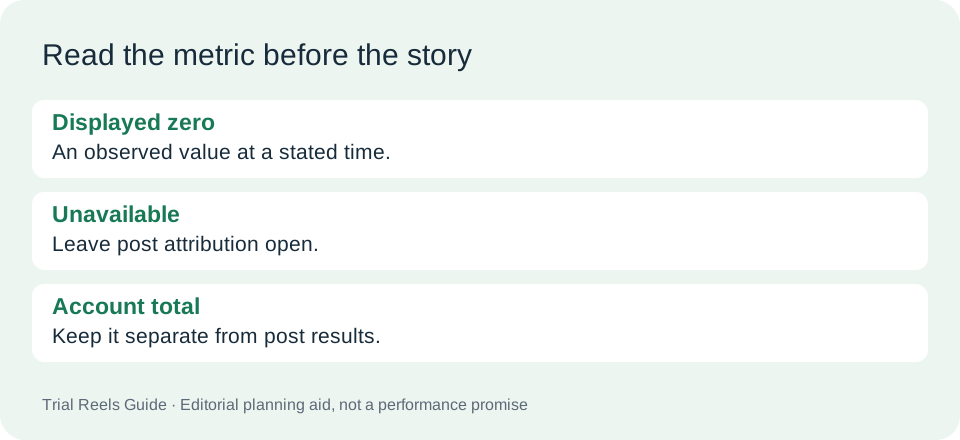
Not necessarily. First identify the record you have. A visible post-attributed zero is an observation about that displayed metric at that capture time. An unavailable metric means you cannot make that observation. An unchanged account total is a different record again; it does not establish which post produced a follow or whether other account activity occurred.
Copy the exact label and capture time. If your account does not display post-attributed follows, write “unavailable” and keep the account total in a separate note. Do not enter an account-wide change in the post column. This is our recordkeeping convention, not a claim about which Insights fields every account must expose.
Choose the next action from that distinction. With an unavailable field, improve the record and review what you can observe. With a displayed zero, review the content promise while retaining the capture time. With an account total alone, avoid assigning a cause to the trial. None of these records identifies a distribution penalty.
Write the reason a stranger would return
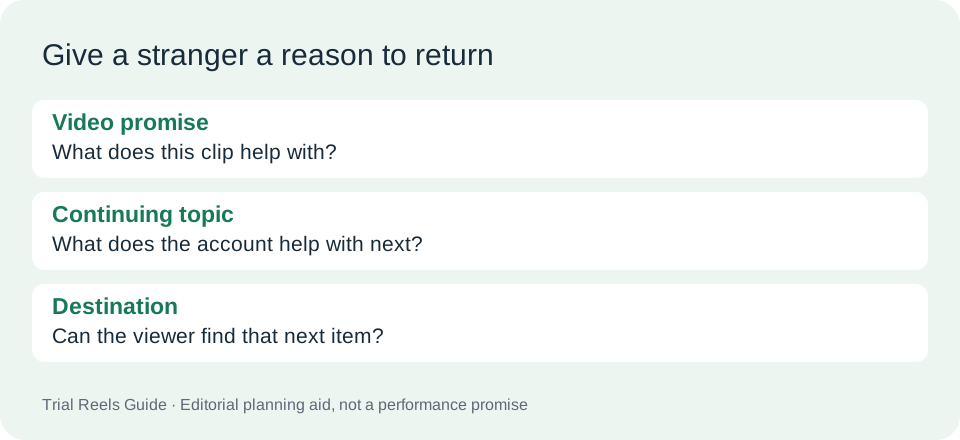
Use this original worksheet before changing the next video. Complete the sentences in your own words: “This Reel helps a stranger with…”; “My profile continues helping with…”; and “The next relevant item they can find is…”. Keep the finished statements beside your tracking record. They are content-planning prompts, not measured explanations of viewer behavior.
If the first sentence describes a one-off spectacle and the second describes an unrelated service, note the mismatch as a hypothesis worth checking. Do not label the audience low quality. A viewer may enjoy the clip without wanting the account's next subject; your counters cannot tell you the viewer's motive.
Read your profile as someone arriving without the context of older posts. Can that person identify the continuing subject and find the item you promised? Check the visible wording and available destination yourself. An unclear destination is something you can edit; it is not proof that this caused the missing follows.
Keep the invitation specific to the content. A clear description of what comes next is easier to evaluate than a generic demand to follow. Do not promise a resource that is absent, and do not imply that editing a bio changes the platform's distribution rules.
An example of a promise that continues
Consider a hypothetical repair creator, not an account we tested. The video demonstrates how to identify a loose cabinet hinge. The profile currently describes unrelated lifestyle posts. The creator's proposed edit is to explain that the account covers small home repairs and make the next relevant repair easy to find.
The learning question is whether the content and destination now describe the same continuing topic. The observation would be the wording and destination actually available, followed by whatever post-level metrics the account exposes. We have no measured outcome for this example and no basis to predict one.
For an alternative hypothetical creator, a product reaction may be a complete experience with no continuing series intended. The useful decision may be to keep it as discovery content and choose another post for a continuing-topic invitation. Not every view needs to serve the same editorial goal. Record that goal before judging the next upload.
Choose a next action without declaring a cause
When the metric is missing, your next action is better documentation. When the video and profile promise different subjects, your next action can be a clearer destination. When the subject already matches, your next question can concern the specificity of the follow-up invitation. These are proposed editorial actions, not a diagnostic ranking of proven causes.
Write the intended change before publishing again. Keep the prior script, profile wording, sharing status and capture record. Note other changes, including topic or timing. Our comparison guide explains why separate uploads do not automatically form a controlled experiment. A later difference can inform your next question without establishing that your edit caused it.
Do not delete the current trial merely to manufacture a cleaner story. Preserve the evidence you already have. If you choose a later review, record its actual time and displayed values rather than reconstructing a missed snapshot. Use our auto-sharing guide when a sharing transition complicates the record.
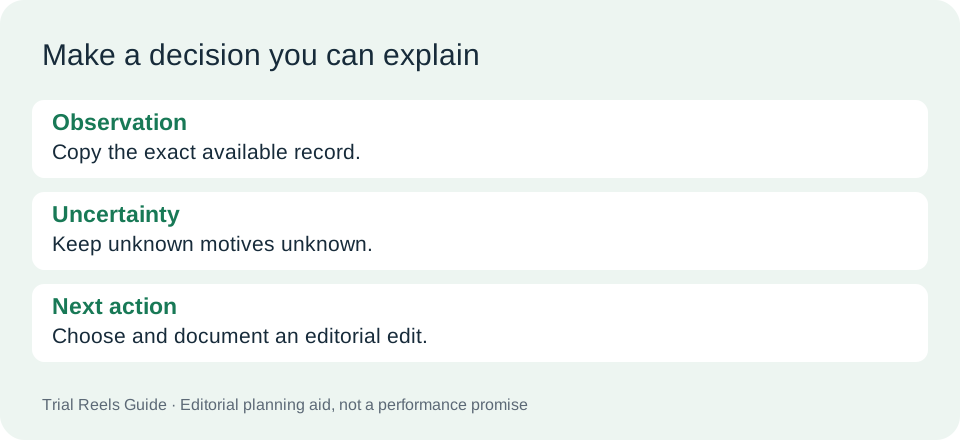
A useful closing note has an observation, an uncertainty and an action: “Post-attributed follows unavailable; viewer intent unknown; clarify the continuing topic and retain the next capture.” This example contains no performance data. Its value is that another person can understand what you know and why you chose the next step.
Questions before your next Trial Reel
Should I change the hook because follows are missing?
Only treat that as a proposed creative edit. First check the metric and the continuing-topic promise. Missing follows do not identify the hook as the cause. If you change it, retain the old script and describe what else changed.
Does this mean Trial Reels are failing?
The available record does not settle that question. State the goal you chose and the evidence you have. Discovery, interest in another post and a follow are distinct things to investigate; one counter cannot explain all of them.
What follows-per-view rate should I target?
This guide establishes no target. We have no comparable account dataset or verified post-attribution denominator here, so we do not calculate a rate or substitute another creator's results for your observations.
What should I save for the next review?
Keep the post reference, exact available metric labels, capture time, sharing status, content promise and destination wording. Keep proposed actions separate from changes already made. Leave unavailable values unavailable.