Publishing two Trial Reels does not, by itself, establish a controlled A/B test. Treat their results as observations about separate posts unless you have evidence of comparable conditions and random audience assignment. A higher count can guide your next question without proving that the opening caused the difference.
What the feature description establishes
Trial Reels are shown to non-followers first. Publishing, reviewing engagement and choosing wider sharing are available actions. A creator-controlled randomized split between two versions is unverified; Instagram's internal allocation remains unknown.
NIST's experimental-design guidance explains why factors other than the change of interest can affect a result, and why control and randomization matter. Applying that principle to separate posts is our editorial interpretation. Two uploads are not enough to isolate a cause.
Write the question before making a second version
Choose a question you can actually investigate. For an opening, ask whether the viewer can identify the problem before the explanation begins. Decide which visible response would help you review that question. Do not switch from clarity to raw reach after seeing the counters.
Keep an unchanged copy of each script. Mark the intended change and every accidental change. If the second version has a new opening, new music and a shorter body, describe it as a different package. Calling it a hook test hides the other changes.
A comparison record you can copy
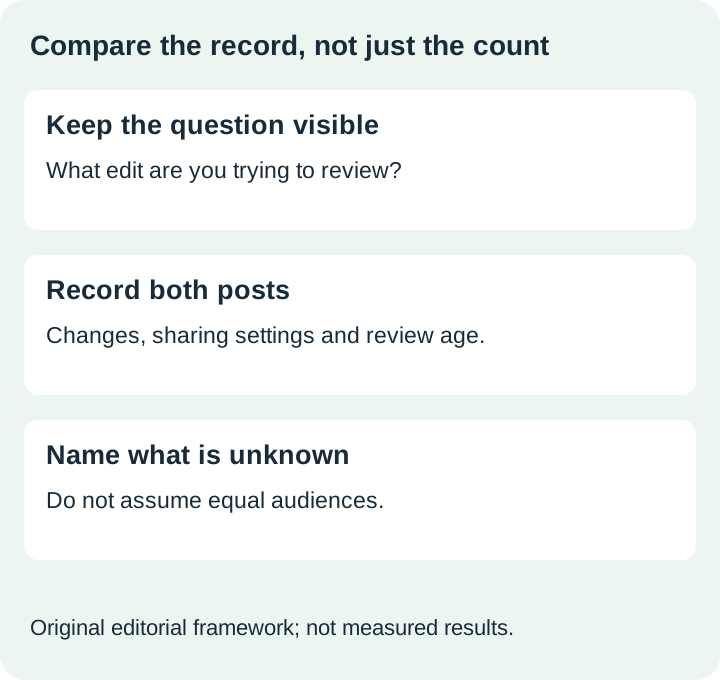
Record these fields for both versions:
- Question: what are you trying to learn?
- Intended change: quote your own opening or describe the edit.
- Other changes: body, duration, caption, cover, audio and call to action.
- Posting conditions: timestamp, time zone and sharing setting.
- Review conditions: timestamp and age of the post when reviewed.
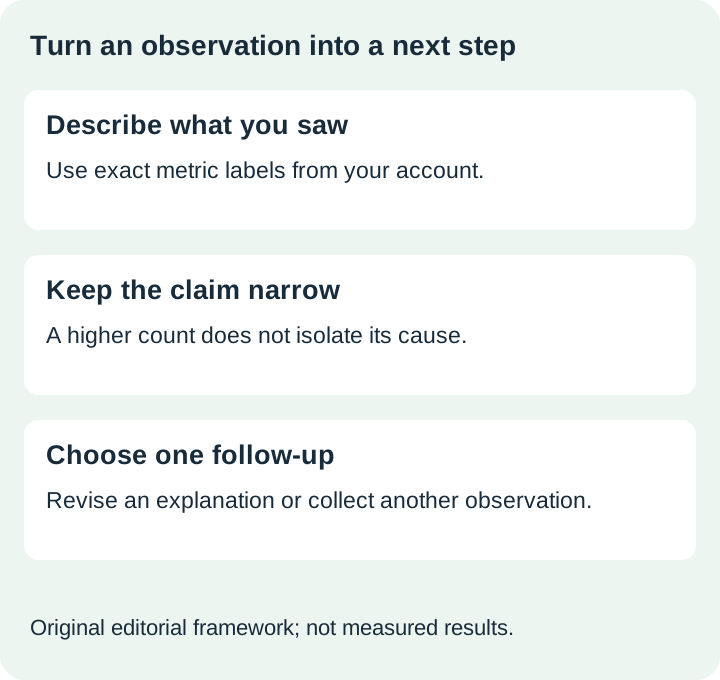
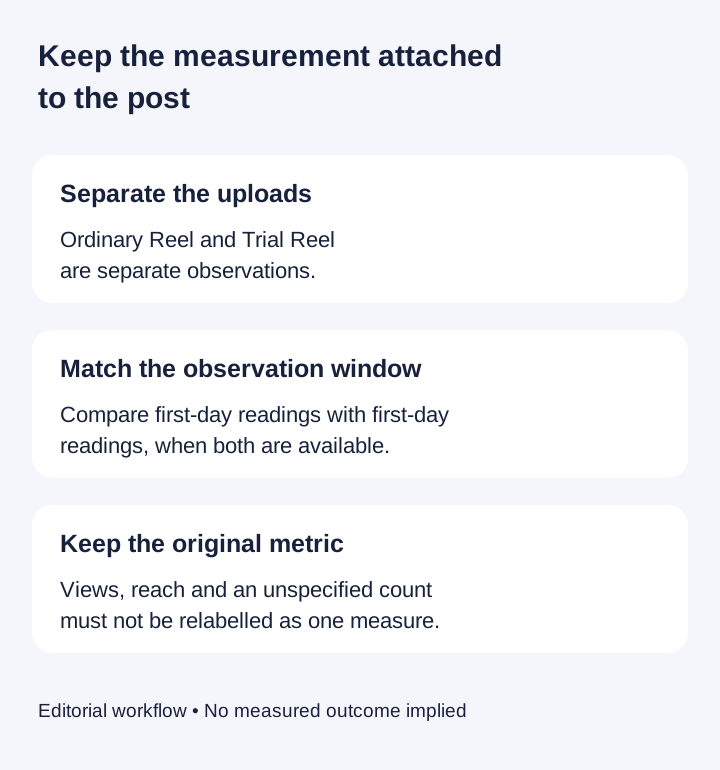
- Observations: exact metric labels and values visible in your account.
- Missing information: unavailable metrics and unknown audience overlap.
- Interpretation: what the evidence supports and what remains uncertain.
- Next action: one specific revision or another observation to collect.
Unknown is a useful entry. Do not replace it with an assumption that the two posts reached equivalent audiences. Record an unavailable metric as unavailable, rather than zero. If one post has already been shared more widely, flag the change before comparing it with a trial that has not.
For a downloadable sheet and definitions of each logging field, use the Trial Reels tracking template.
Example interpretations
These are hypothetical editorial examples, not account results.
If the second post has more views but was reviewed later in its life, write that its count was higher at a different review age. The record does not isolate the opening. Review at a comparable age next time, while still acknowledging that audience allocation is unknown.
If a new opening and new audio accompany more responses, describe the revised package and its observed response. Keep the audio unchanged in a later comparison if the opening remains your question. This reduces one ambiguity without turning organic distribution into a randomized experiment.
If comments on either version ask what the product does, use those comments to revise the explanation. They are a concrete editorial signal, even when the difference between view counts cannot be attributed to one edit.
Can I call one version the winner?
You can choose which version to develop next. Explain the criterion and the observation behind that choice. Avoid saying that you proved a causal lift or that the same result will recur. An editorial choice needs a reason; it does not require an invented certainty.
What should I do next?
Use the record to separate the change you made from conditions you did not control. Keep the explanation that addresses your audience question, and plan one follow-up. For publishing steps, use the site's existing how-to guide; this page answers the separate question of how to interpret a comparison.
For publishing steps, read how to use Instagram Trial Reels. For next steps, see what to do after your first trial.
Were the audiences split for a proper A/B test?
Do not assume that they were. The public feature description explains trial distribution and review, but it does not give creators a documented control for randomly assigning viewers between two versions. Without evidence of how the audiences were assigned, describe the uploads as a comparison of separate posts. That wording preserves what you observed without claiming an experimental design you did not verify.
Does a successful trial guarantee that a follow-up will work?
No. A result from one post is an observation about that post. Keep a separate record for the follow-up and explain what changed. Choosing a related idea is an editorial decision, not a promise that its reach or responses will repeat.