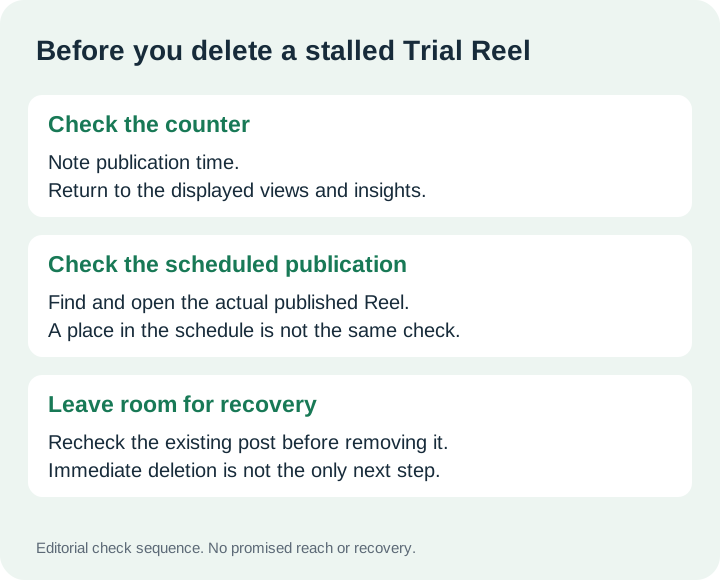
If your Trial Reels are stuck at zero views or have unavailable insights, work through these checks before deleting anything:
- Check for a delayed counter. Note when you published and check the displayed views and insights again later. The numbers can arrive late, so an early zero is a reason to recheck before changing the video.
- Check whether the scheduled trial actually published. Find and open the published Reel rather than relying on its place in the schedule. If it opens but still has no usable data, keep the scheduled result separate from any later manual upload; the two can behave differently.
- Leave room for recovery without another change. Keep the current post in place and check it again later. Activity has resumed without another intervention in that case, so immediate deletion is not the only next step.
Go through all three before removing a trial. Then assess whether a proposed fix addresses what you actually found. The sections below show how to weigh conflicting recommendations without turning one successful outcome into a rule for every upload.
Separate a reusable idea from an unrestricted upload strategy
A video that previously attracted the audience you want can give you a useful starting idea. That does not establish that uploading the identical file repeatedly will keep producing useful results. Relevance and repeat distribution are separate questions.
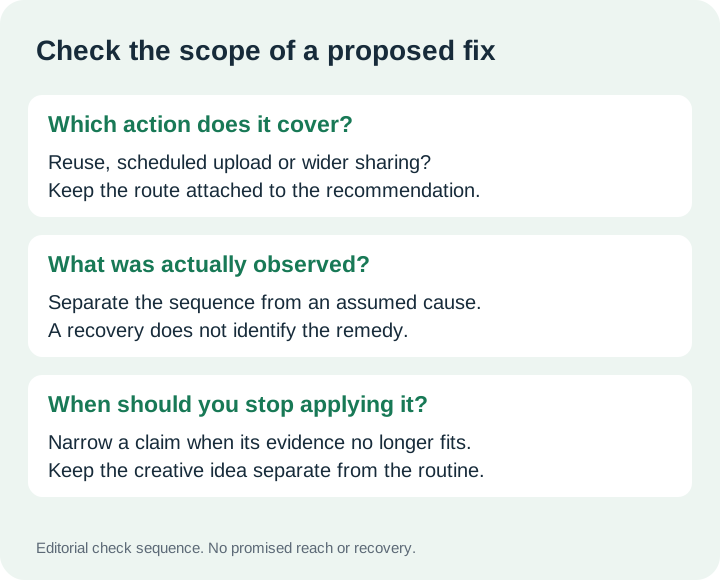
Before adopting a reuse recommendation, identify its actual scope: an older regular Reel becoming a trial, another copy of an existing trial, or a trial becoming a regular post. Do not flatten those routes into “reposting works.”
A useful Trial Reels recommendation needs an expiration check, not just a success story. Look for when the result was observed and what happened on the account you are using now. If that information is missing, keep the suggestion as a possibility rather than a posting commitment. An older result cannot certify today's conditions.
Keep the publishing route attached to the recommendation
Scheduling advice concerns how a post gets published. Creative advice concerns what the viewer receives. Mixing them makes a weak diagnosis look like a useful editing instruction.
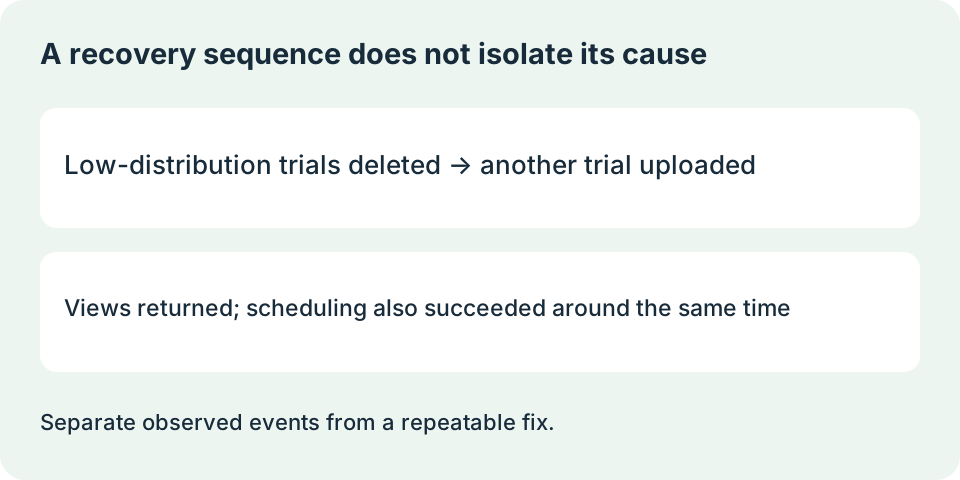
If a scheduled upload produces no usable information, changing the opening does not establish whether scheduling contributed. If a later manual upload records activity, that establishes an observation about the later upload; it does not isolate the publishing method from the elapsed time or other differences.
Use the narrowest description you can support: “Activity appeared after a manual upload” is different from “Manual posting fixed the problem.” The first preserves the sequence. The second adds a cause you have not demonstrated.
Ask what a counterexample actually rules out
An explanation that blames background music needs to account for a similar symptom on a video without background music. That counterexample weakens the claim that background music is necessary for the symptom. It does not prove that audio never matters.
Removing a suspected cause from your upload does not establish that the remaining causes are harmless. Likewise, an account-status check that shows no warning does not explain every publishing or measurement problem. Keep the result of each check within its scope.
This is where conflicting experiences become useful. They help reject explanations that claim too much, even when they cannot supply a replacement diagnosis.
Separate a recovery from a repeatable remedy
Suppose activity appears after you wait, delete, upload again, and change the publishing method. This is a hypothetical sequence, not a measured case study. The recovery does not tell you which action mattered. Repeating the whole sequence would repeat the uncertainty too.
Before recommending a remedy to yourself, ask whether the record distinguishes recovery after an intervention from recovery without that intervention. When both remain plausible, label the remedy unconfirmed. Avoid converting a reassuring outcome into an instruction to delete every stalled trial.
Does more reach mean the advice served your goal?
Not by itself. If your purpose is to attract people interested in your subject, inspect the responses available to you for that connection. Attention to an unrelated topic can leave the original audience question unanswered.
Review the promise made in the Reel alongside what your profile actually offers. Someone arriving for a particular explanation should be able to recognize that subject there. This is a communication check, not a claim about Instagram's ranking system.
Give each recommendation a stopping condition
Keep a suggestion only while its scope and evidence remain useful. If it assumes unrestricted repetition, a particular publishing route, or a cause that your observations cannot establish, narrow it before applying it again.
Retire the claim before you retire the creative idea. You can still develop the subject while declining an unsupported upload routine. The practical result is a smaller set of recommendations you can explain, rather than a larger collection of tricks you cannot evaluate.