What the platform’s timing actually means
Meta’s Trial Reels announcement says engagement metrics become available approximately 24 hours after sharing. That is an approximate insights point, not a moderation approval or a promise of audience delivery. Optional automatic sharing is conditional on performance assessed from views within the first 72 hours. It is not a guaranteed publication appointment.
Buffer’s first-person guide cautions that a trial needs time to develop before wider sharing or deletion, and specifically flags sponsored content with a hard deadline. That caution motivates the planning worksheet below; it does not supply a tested minimum lead time for your account.
Separate the experiment from the promised release
Write the deadline in the time zone you will use when acting. Then define what must be true by that point: the upload must open, the intended audience setting must be selected, and the content must contain the promised message. Do not silently substitute “started a trial” for “made the required release.” This worksheet organises the publishing decision; it does not interpret an agreement or certify delivery to every follower.
Choose an earlier decision cutoff that leaves you room to take the fallback action yourself. The interval is yours to select from your actual availability and publishing checks, not a universal number borrowed from another account. If you cannot name a realistic time to act, the experiment is not a dependable part of this particular release plan.
| Your situation | Editorial choice | Evidence to keep |
|---|---|---|
| You can review the trial and still act before the deadline | Run the optional experiment, then make a deliberate release decision | The upload, review time, insights actually present and final sharing state |
| The deadline arrives before you can review useful insights | Skip the trial for this release or end the experiment at your cutoff | The chosen publishing route and the upload that actually opens |
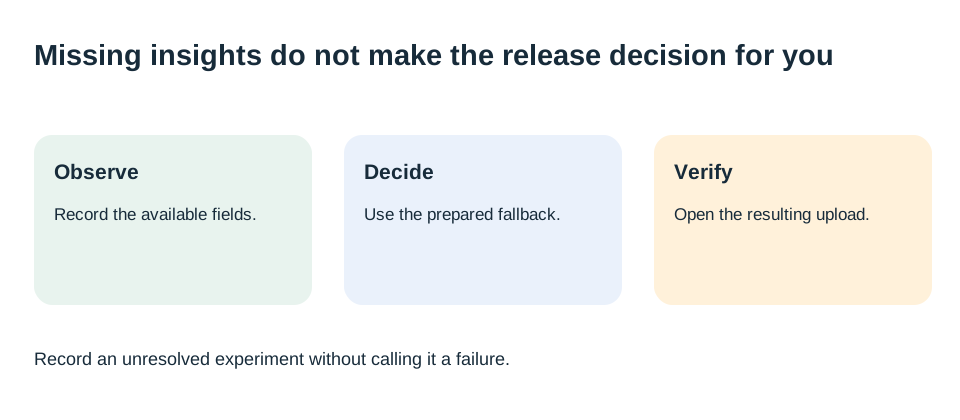
| Insights remain unavailable at the decision cutoff | Use the prepared fallback rather than inventing a result | The missing field, your decision and the resulting publishing state |
| You cannot be available to make the fallback action | Do not make the commitment depend on an unattended conditional release | A publishing plan you can actually operate and verify |
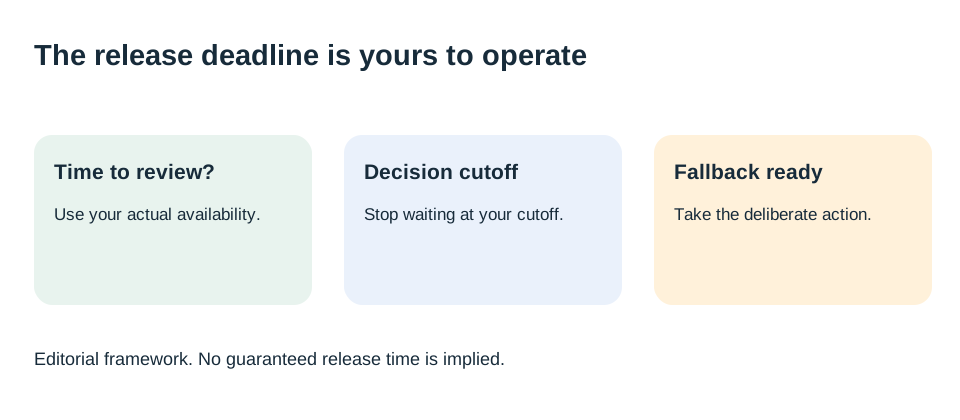
Keep the fallback small and concrete. It may be a deliberate wider-sharing action on the existing trial, or the normal publishing route you chose in advance. These are planning options, not claims that every account presents identical controls. Verify the available action in your own app. Avoid creating an accidental duplicate because you lost track of which upload the deadline refers to.
At the cutoff, record the visible state before changing it. A displayed view count describes a measurement; it does not show that the intended release happened. Conversely, a published upload with sparse data can still be an identifiable publishing event. Keep performance and publication in separate fields so neither one becomes a substitute for the other.
A deadline worksheet for one account and one release
Fill this in before posting. Blank entries are intentional: this is an original worksheet, not a completed sponsorship case or a claimed experiment. You do not need a team, a client approval dashboard or another person’s private analytics to use it.
| Field | What you enter | Why it matters |
|---|---|---|
| Release requirement | The message, format and audience you need to publish to | Defines the event you will later verify |
| Deadline and time zone | Your actual date, time and time zone | Prevents two different clock readings being treated as one |
| Decision cutoff | When you will stop waiting for the trial | Makes the fallback an actionable choice |
| Trial question | The single content question you want to explore | Stops the experiment from becoming a vague delay |
| Current upload | The exact draft or published Reel you are reviewing | Keeps similar versions from sharing one history |
| Automatic sharing state | What the account currently shows, and when checked | Separates a selected setting from an observed release |
| Fallback action | The publishing action you can take yourself | Removes dependence on a conditional outcome |
| Completion record | The upload link, observed state and check time | Documents the result without claiming every follower received it |
Download the blank deadline worksheet (CSV). It contains fields and prompts only; it does not contain account data.
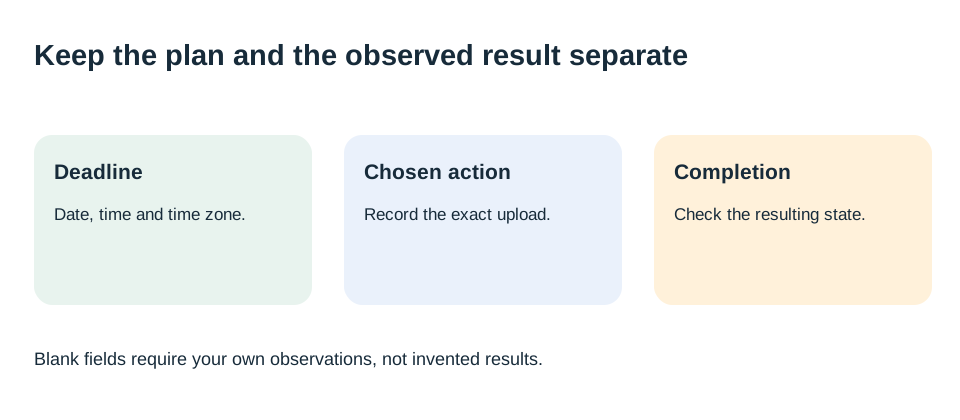
After the release, leave the original plan intact and add what actually happened. If the trial was abandoned because the cutoff arrived, write that rather than calling the creative idea a failure. If you used the fallback, record that action rather than describing the release as proof that automatic sharing worked.
You can reuse the worksheet for a later release, but give each upload its own record. Do not carry an earlier result forward as evidence that the same timing will work again. A successful publishing sequence is an observation about that sequence, not a guarantee for a different deadline or account state.
Questions before a deadline
Does “approximately 24 hours” mean the content has passed review?
No. The official statement concerns when engagement metrics can be viewed. It does not provide an approval deadline. Treat missing insights and any actual publishing notice as different observations.
Can I promise that automatic sharing will release it after 72 hours?
The official description is conditional. If you need a release at a particular time, do not make that promise depend solely on the automatic option. Keep a deliberate action and a way to verify its result in your plan.
What if I reach my cutoff without enough data?
Use the fallback you selected and label the experiment unresolved. You do not need to manufacture a performance conclusion to make a time-bound publishing decision.
Should I use a trial to keep an announcement secret before launch?
Do not treat a trial as a private preview. The feature is designed to expose the content to non-followers, and documented indirect routes can also expose it to followers. The deadline worksheet controls your decision, not secrecy.
Sources and limits
The feature timings above are official documentation, attributed inline. The deadline caution is attributed to Buffer. The decision table, blank worksheet and illustrations are our editorial framework. We have not run a sponsored-content deadline experiment, and this page contains no measured success rate or promised minimum lead time.
For the general setting, read how Trial Reels auto-sharing works. For the act of wider release, use the guide to sharing an existing trial. This page focuses on the deadline decision rather than repeating either guide.