Trial Reels are worth considering when your question is whether an unfamiliar audience understands a new idea. They are less useful as your only test when the content depends on an existing relationship with your followers. Decide what you want to learn before publishing, then judge the response against that question rather than an invented view target.
This guide offers an editorial decision method. It does not describe an Instagram ranking formula or promise a particular result.
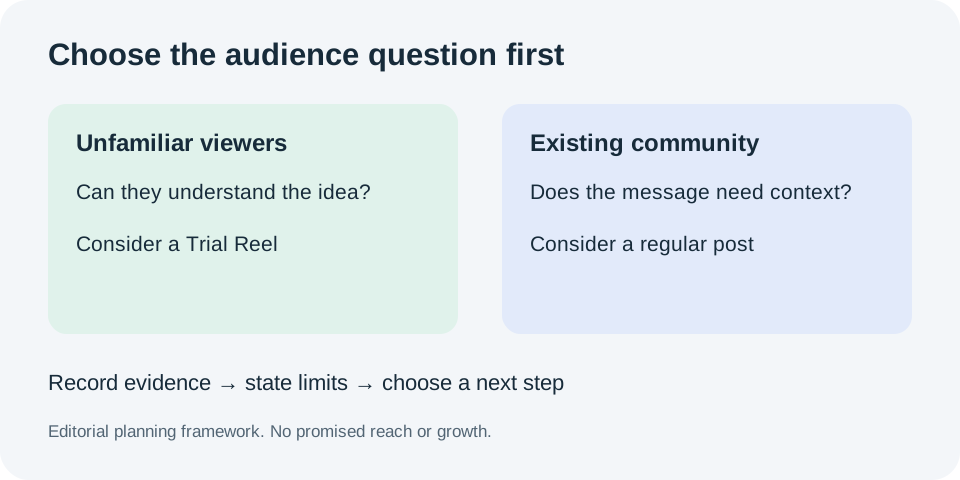
Start with the audience the idea needs
Meta describes Trial Reels as a way to show content to non-followers first and explore new topics or formats before deciding whether to share more widely. That makes the feature relevant to a question such as: “Would someone who has never seen my account understand this?” .
A different question needs a different interpretation. If you are thanking your community, continuing a discussion, or announcing a change to an existing service, recognition and context may be central to the message. A stranger’s response cannot, by itself, answer how your established audience will react.
| Content idea | What a trial could help you explore | What it cannot establish by itself |
|---|---|---|
| A beginner explanation | Whether the opening makes the topic understandable | Whether existing followers want another introductory post |
| A new storytelling format | Whether the format invites responses from unfamiliar viewers | Whether changing your entire content strategy is justified |
| An update to an ongoing series | Whether the update works without earlier installments | Whether regular viewers value the continuation |
| A service announcement | Whether a stranger understands the offer | Whether existing customers have received or understood the update |
The table is a planning aid, not a platform rule.
Give a stranger enough context
Consider a creator who usually posts advanced editing tutorials and wants to explain a basic editing mistake. An opening such as “You’re still doing this wrong” assumes the viewer already knows what “this” means. An opening that names the problem gives an unfamiliar viewer a clearer starting point.
Before publishing, check the message without relying on your biography, earlier posts, or an existing reputation:
- Can the viewer identify the problem from the opening?
- Does the example make sense without another post?
- Does the ending invite a response connected to the question you are testing?
These are editorial checks. They do not guarantee distribution or engagement.
Choose evidence that can answer your question
“Did this reel do well?” is difficult to act on. “Did unfamiliar viewers understand the explanation?” gives you something specific to review.
Views can tell you that viewing activity was recorded, but a view count alone cannot establish understanding. Comments asking what the subject is may suggest missing context. Comments discussing the actual problem may suggest that at least those commenters understood it. Neither observation represents everyone who watched.
Keep a short note with the intended audience, the question, the evidence you observed, and the limitation. If no meaningful responses are available, record that the question remains unanswered. Do not turn missing evidence into a claim that the idea is bad or that the account is restricted.
Should every reel be a Trial Reel?
Our editorial recommendation is to choose the format according to the audience question. Use a trial when learning from unfamiliar viewers is relevant. For content directed at people who already know you, consider whether a regular post better serves the communication goal.
Meta also notes that trial content is not completely hidden from followers: they may encounter it through routes such as a direct-message share. Treat a trial as an audience-testing feature, not a confidentiality setting.
Write the next decision before the next post
Finish your review with a concrete statement: “The explanation needs more context,” “This format deserves another test,” or “The available evidence does not answer the question.” Then choose a change connected to that statement.
Trial Reels become more useful when you can explain what you learned and what remains uncertain. The next post should follow that reasoning, rather than a promise that a particular posting pattern will unlock growth.